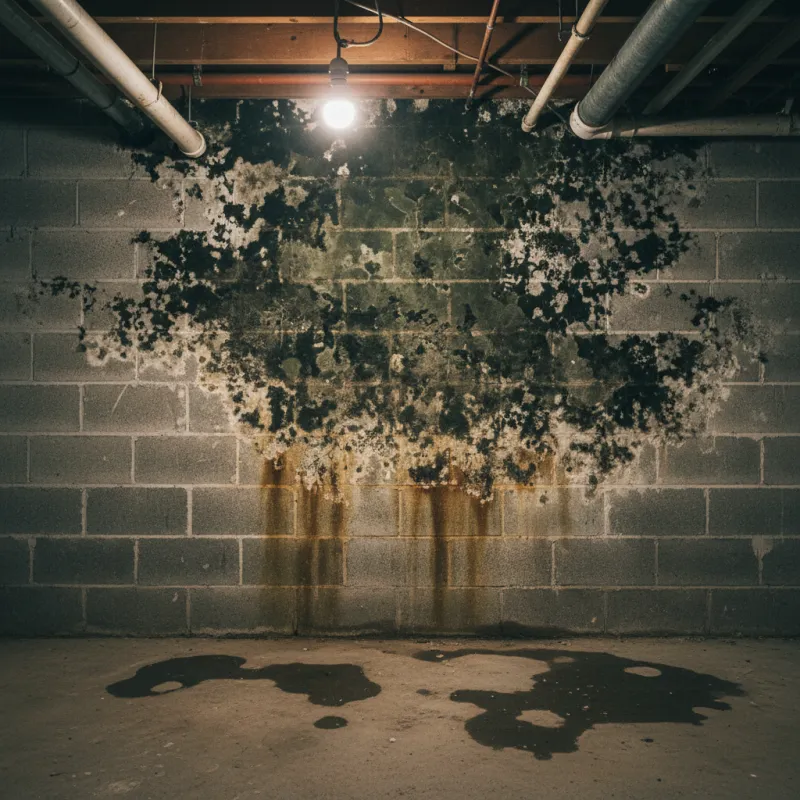
The Short Version
- The EPA says mold over 10 sq ft requires professional remediation — that's roughly the size of a bathroom door.
- Bleach doesn't kill mold roots on porous surfaces. It removes the color and leaves the colony intact.
- Hidden mold, HVAC contamination, and health symptoms are non-negotiable professional-only situations.
- The average professional mold remediation job costs $1,500–$4,000. Ignoring it can cost $10,000–$30,000+ in structural damage.
Most mold problems start small — a dark patch in the corner of the bathroom, some discoloration near a window. The natural instinct is to grab cleaning spray, scrub it off, and move on. That works for about 30% of mold situations. For the other 70%, you're not solving the problem. You're rearranging it.
The difference between a $200 cleaning job and a $15,000 remediation project often comes down to whether you called a professional at the right time. Here are the seven signs that your situation is firmly in the "call a professional now" category.
What's In This Guide
The Affected Area Is Larger Than 10 Square Feet
The EPA published its Mold Remediation in Schools and Commercial Buildings guidelines, which set the 10 square foot threshold as the dividing line between homeowner-manageable and professionally required. That's roughly a 3×3 foot patch — smaller than a standard bathroom door.
Here's why that number matters: mold colonies you can see on the surface represent only part of what's actually there. Mold has hyphae — root-like structures — that penetrate porous building materials like drywall, insulation, and wood framing. What looks like a 10 square foot surface stain may involve 30+ square feet of contaminated substrate behind the wall.
How to Measure Accurately
Don't just measure what you can see. If you notice mold on drywall, assume the contamination extends at least 12 inches in every direction beyond the visible boundary. Check inside cabinets, behind appliances, and underneath flooring near the affected area. If any of those measurements push you past 10 square feet total, you're in professional territory.
A small mold colony doubles in size roughly every 1–2 weeks under favorable conditions (humidity above 60%, temperatures between 60–80°F). A 15 sq ft patch becomes a 60+ sq ft remediation project in about a month. Most homeowners insurance policies exclude mold damage that resulted from neglected maintenance — meaning you pay out of pocket for all of it.
DIY Approach
- Removes visible surface growth
- Doesn't address contaminated substrate
- No air quality testing before/after
- No containment — spreads spores to other rooms
- No documentation for insurance
Professional Remediation
- Full scope assessment including hidden areas
- Physical containment with negative pressure
- HEPA filtration during removal
- Substrate testing and replacement if needed
- Post-clearance air quality testing
Small-to-medium remediation (10–50 sq ft): $1,500–$3,500, typically 1–2 days. Larger jobs involving wall cavity or structural material removal: $4,000–$10,000+, 3–5 days. The biggest cost driver is whether drywall and framing need to be replaced.
Not Sure How Big Your Problem Is?
A certified remediation specialist can assess your home, give you a scope of work, and tell you honestly whether it's DIY-able or not. Most offer free phone consultations.
Call (888) 751-3962Free, no-obligation phone consultation. Local specialists available now.
You Can Smell Mold But Can't Find It
Mold produces a musty, earthy odor that comes from microbial volatile organic compounds (MVOCs) — chemical byproducts of mold metabolism. If you can smell mold but can't locate it, that's not a good sign. It means the colony is growing somewhere you can't see: inside wall cavities, under flooring, in your crawl space, behind kitchen or bathroom cabinets, or in the ceiling above drywall.
The smell is often strongest near the moisture source, but it disperses through your HVAC system. Chasing the smell without understanding moisture pathways is how homeowners spend $500 on products that do nothing. You need to find the source of the moisture, not just the mold.
Common Hidden Mold Locations
- Inside wall cavities — a slow pipe leak behind drywall creates perfect mold conditions for months before you see visible damage
- Under hardwood or laminate flooring — particularly near sliding glass doors, dishwashers, or refrigerators with water lines
- In crawl spaces — inadequate vapor barriers turn crawl spaces into mold nurseries; the odor moves up through subfloor gaps
- Above drop ceilings — any roof leak or HVAC condensation issue can hide mold in plenum spaces for years
- Behind bathroom tile — failed grout or caulk allows moisture into the cement backer board and framing behind
Hidden mold causes two compounding problems: structural damage and air quality degradation. Mold in wall framing can compromise load-bearing members over time. More immediately, mold spores and MVOCs circulate through your home continuously, affecting everyone who breathes indoor air. You cannot solve hidden mold with surface cleaning — you don't know where to clean.
What a Professional Does Differently
Certified mold inspectors use moisture meters, thermal imaging cameras, and borescope cameras to locate hidden moisture and mold without tearing into every wall. A competent inspector can typically identify the source of hidden mold in 1–2 hours for $300–$500. That assessment tells you exactly where to remediate and what caused it — which means the fix actually works.
Professional mold inspection: $300–$600. If mold is confirmed behind walls, add demolition and remediation costs: $2,000–$6,000+ depending on extent. Timeline: inspection same-day or next-day, remediation typically 2–4 days after scope is determined.
Someone in Your Household Has Health Symptoms
This is not a "wait and see" situation. If someone in your home — particularly children, elderly family members, or anyone with respiratory conditions, asthma, or compromised immunity — is experiencing unexplained symptoms, and you have or suspect mold, call a professional today.
Mold exposure symptoms vary by mold type, exposure duration, and individual sensitivity. Common presentations include:
- Chronic nasal congestion or runny nose that doesn't respond to allergy medication
- Persistent cough, wheezing, or shortness of breath (especially when indoors)
- Eye irritation — redness, watering, blurred vision
- Skin rashes or unexplained hives
- Fatigue and cognitive fog that improves when you leave the house
- Headaches that are consistently worse at home
- Worsening asthma attacks without a clear trigger
The "worse at home, better away" pattern is the clearest indicator. If someone feels better after a weekend away and worse upon returning, indoor air quality is almost certainly involved.
Mold-related illness is cumulative. The longer someone is exposed, the more sensitized they become, and the lower the exposure threshold required to trigger symptoms. Some individuals develop chronic inflammatory response syndrome (CIRS), a systemic condition that can persist long after mold removal if exposure continues too long. This is not theoretical — it's documented in peer-reviewed medical literature and affects roughly 25% of the population due to a genetic variant in the HLA-DR immune pathway.
On Stachybotrys ("Black Mold"): Not all black mold is Stachybotrys, and not all Stachybotrys is the highly toxic strain. But if you have health symptoms + black mold + moisture, you need a professional air quality test, not a bleach bottle. Testing costs $150–$400. The alternative is guessing wrong with your family's health.
DIY Approach
- No air quality baseline before or after
- Disturbing mold releases massive spore burst
- No respiratory protection for homeowner
- Cannot confirm remediation was successful
- No documentation for doctor or insurer
Professional Remediation
- Air quality testing identifies specific mold species
- Full PPE and containment prevent exposure during removal
- HEPA air scrubbers run throughout process
- Post-clearance testing confirms air quality restored
- Written clearance report for medical records
Air quality testing: $150–$400. If mold confirmed: full remediation $1,500–$6,000+ based on scope. Get a clearance test after ($150–$300) to confirm spore counts are back to normal. Total timeline from call to clearance: typically 5–10 days.
Health Symptoms? Don't Wait for a Second Opinion.
If your household is experiencing mold-related symptoms, every day matters. Compare local certified remediation specialists — free phone consultation, no commitment required.
Call (888) 751-3962Available now. Talk to a local specialist in under 2 minutes.
Mold Keeps Coming Back After You Clean It
If you've cleaned the same patch of mold two or more times and it keeps returning within a few weeks, you do not have a cleaning problem. You have a moisture problem — and possibly a structural problem. The mold is a symptom. Treating it with surface cleaners without addressing the moisture source is like mopping up a leak without fixing the pipe.
The other issue is that bleach, the default DIY mold remover, is fundamentally misunderstood. Bleach kills mold on non-porous surfaces like glass, tile, and sealed concrete. On porous surfaces — drywall, wood, grout, caulk — bleach's water content actually penetrates into the material and can feed mold growth while the sodium hypochlorite sits on the surface. The mold looks gone. The root structure is still there and actively growing.
What "Keeps Coming Back" Actually Means
Recurring mold in the same location almost always means one of three things:
- Ongoing moisture source — a slow pipe leak, inadequate ventilation, or groundwater intrusion that hasn't been fixed
- Incomplete previous removal — surface cleaning left viable mold roots (hyphae) in porous materials, and regrowth was inevitable
- Reservoir colony elsewhere — a larger, untreated mold colony in a wall, ceiling, or crawl space is continuously re-seeding visible surfaces via air circulation
Recurring mold is self-reinforcing. Each cleaning cycle that fails to remove the root structure allows the colony to recover and expand. The more material that becomes contaminated, the larger and more expensive the eventual remediation. Materials that could have been cleaned are now materials that must be replaced. A $300 problem becomes a $3,000 problem in about six months of recurring "cleanings."
How Professionals Stop the Cycle
A good remediation company does two things a homeowner can't: identify the moisture source and physically remove contaminated material. They don't wipe over mold — they cut out the affected drywall, insulation, or wood and replace it with clean material after treating the cavity. They also make moisture control recommendations (or coordinate with a plumber or waterproofing company) so the conditions that caused growth are eliminated.
When mold requires material removal and replacement: $2,000–$5,000 for a typical bathroom or single-room scenario. If the moisture source requires plumbing repair or waterproofing, add $500–$3,000+ for that work. The full fix typically takes 3–5 days between remediation and material replacement.
Mold Is in Your HVAC System or Ductwork
HVAC mold is categorically different from surface mold in one critical way: your air handler and ductwork are designed to distribute air to every room in your house. Mold in your HVAC system is mold that gets delivered to every room at every HVAC cycle. A small colony in your air handler can seed mold growth throughout your entire home within weeks.
Signs that mold may be in your HVAC system include:
- Musty odor that occurs only when the HVAC is running, not when it's off
- Visible black or green growth around air supply vents or on vent covers
- Mold recurring simultaneously in multiple rooms — not concentrated in one area
- Allergy or respiratory symptoms that are worse when the HVAC runs
- Visible growth on evaporator coils (check by removing the front panel of your air handler)
Why This Is Never a DIY Job
Disturbing mold in ductwork without proper containment and filtration doesn't remove the problem — it aerosolizes it. Running your HVAC after attempting to clean visible duct mold without professional equipment will distribute spores throughout your home at a concentration many times higher than the pre-cleaning baseline. You need HEPA-equipped duct cleaning equipment, negative pressure containment, and an EPA-registered antimicrobial treatment applied to duct surfaces after cleaning.
Turn off your HVAC if you suspect duct mold and are waiting for a professional. Running it continuously while mold is present accelerates whole-home contamination. Use fans and open windows for ventilation in the interim.
HVAC mold contamination that spreads to wall cavities and multiple rooms can turn a $2,000–$4,000 duct cleaning job into a $15,000–$25,000 whole-home remediation. Beyond cost, untreated HVAC mold makes it essentially impossible to maintain livable indoor air quality — every time you run the system, you're re-exposing your household.
Professional HVAC mold remediation: $1,500–$4,000 for the air handler and main ducts. If mold has spread to supply/return branch ducts throughout the home, costs can reach $5,000–$8,000+. Timeline: typically 1–2 days for HVAC-only remediation, longer if whole-home remediation is also required.
HVAC Mold Is a Same-Week Problem
Every hour your system runs, contaminated air circulates through your home. Get a specialist on the phone now to understand your options.
Call (888) 751-3962Local specialists. Free consultation. Real answers, not a sales pitch.
You've Had Recent Water Damage or Flooding
Mold does not need weeks to establish. Under the right conditions — temperatures between 60–80°F, organic material (drywall, wood framing, insulation), and humidity — mold can begin colonizing a wet surface in as little as 24–48 hours. Most homeowners don't realize this means the window for prevention, not remediation, is extremely short.
If your home has experienced any of the following in the past 2–3 weeks and you haven't had a professional assess the affected materials, assume mold is present:
- Basement or crawl space flooding
- Burst or leaking pipes that soaked drywall, flooring, or insulation
- Roof leak that allowed water into the attic or ceiling
- Appliance leak (dishwasher, refrigerator water line, water heater) that went undetected for more than 24 hours
- Storm or hurricane flooding
- Fire suppression (sprinkler activation or fire hose) — water damage from fire suppression is often extensive and moves fast
The "It Dried Out" Mistake
The most expensive mistake homeowners make after water damage is assuming the problem is solved once surfaces look and feel dry. Structural materials — wall cavities, subfloor, ceiling joists — retain moisture far longer than surfaces. A wall that looks dry after two days of fans may have wet insulation with 30% moisture content behind it, which is enough to sustain active mold growth for weeks.
Professional water damage restoration includes moisture mapping with calibrated meters that measure moisture content at depth, not just surface readings. They'll tell you what's actually dry versus what just looks dry.
Mold that starts in wet insulation typically stays hidden for 2–4 weeks, then becomes visible as surface staining bleeds through drywall. By the time you see it, you have an established colony with root structures deep in the wall cavity. That's a remediation job, not a cleaning job. The cost difference is typically 5–10x. Additionally, delayed water damage claims are frequently denied by insurance carriers who argue the damage was exacerbated by neglect.
Water damage assessment and drying: $1,000–$3,000 (often covered by homeowner's insurance). Mold remediation if mold has established: add $1,500–$8,000+ depending on scope. The cost differential between calling within 48 hours vs. 2–3 weeks later is often $3,000–$5,000. Insurance claims: document everything with photos before any cleanup begins.
You're Buying or Selling a Home
Real estate transactions are the highest-stakes mold situation, and the one where DIY creates the most legal and financial exposure. Whether you're the buyer or the seller, mold discovered during a transaction needs professional handling — not a quick spray-and-paint job before listing.
If You're Selling
Most states require sellers to disclose known material defects, and mold qualifies in virtually every jurisdiction. Attempting to conceal mold — including painting over it, applying surface treatments to make it less visible, or removing surface growth without addressing the substrate — exposes you to post-sale litigation. Buyers who discover mold after closing regularly pursue sellers for remediation costs, and courts consistently side with buyers when sellers failed to disclose.
The right move is to get a professional remediation done before listing, with documentation. A remediation report showing the problem was professionally resolved is a disclosure that strengthens your sale — it's evidence of a solved problem, not an unresolved liability.
If You're Buying
Never rely on a general home inspection to fully assess mold. General inspectors are not certified mold remediators — they look for visible signs and flag potential concerns, but they don't test air quality, use moisture meters, or assess hidden contamination. If a general inspection flags any moisture issues, mold indicators, or water staining, order a dedicated mold inspection from a certified industrial hygienist (CIH) or certified mold inspector (CMI) before closing.
A $400 mold inspection before closing can prevent you from inheriting a $15,000 remediation problem after you own the home. It also gives you negotiating leverage — documented mold is a hard number you can use to renegotiate the sale price or require seller remediation as a condition of closing.
Sellers who don't disclose: post-sale litigation, remediation cost liability, and potential fraud exposure if concealment is proven. Buyers who skip mold inspection: inheriting contamination at full purchase price, no recourse against sellers who claimed no knowledge. In a $400,000 home transaction, spending $400 on a mold inspection is a 0.1% due diligence cost. Not spending it can mean inheriting a $20,000 problem with no legal remedy.
DIY / No Professional
- No documentation for disclosure or negotiation
- Potential non-disclosure liability post-sale
- Buyers have no recourse if mold wasn't tested
- General inspection misses hidden contamination
- Zero legal protection for either party
Professional Remediation + Inspection
- Written clearance report for legal disclosure
- Documented evidence of resolved problem
- Buyer has objective data for negotiation
- Air quality testing confirms livable conditions
- Full protection for both buyer and seller
Buyer mold inspection: $300–$600 with air quality testing. Pre-sale remediation (seller): varies by scope, typically $1,500–$5,000 for average residential mold issues. Budget 1–2 weeks for inspection + remediation + clearance testing if you're on a closing timeline. Factor this into your transaction schedule — don't leave it for the last week.
Ready to Talk to a Certified Specialist?
We connect homeowners with licensed, insured mold remediation companies. Describe your situation, get a same-day call back, and compare options before you commit to anything.
Call (888) 751-3962Free consultation. No pressure. Available 7 days a week.
What to Do Right Now
Run through this checklist honestly:
The 7 Signs — Quick Reference
- 10+ sq ft: Call a professional. This is the EPA's own threshold.
- Smell without source: Get a mold inspection with moisture mapping before you do anything else.
- Health symptoms: Call today. This is a health issue, not a home maintenance issue.
- Recurring mold: Stop cleaning it. Get the moisture source identified and the substrate replaced.
- HVAC involvement: Turn off the system. Call a professional before running it again.
- Water damage in past 3 weeks: Even if it looks dry, get a moisture assessment now.
- Real estate transaction: Buyer = get a dedicated mold inspection. Seller = remediate and document before listing.
The cost of a professional consultation is almost always less than the cost of finding out three months later that you made it worse. Most certified remediation specialists offer free or low-cost phone consultations where they can tell you — based on what you describe — whether your situation requires professional intervention or whether you genuinely can handle it yourself.
Use that call. The information is free. The mold problem won't stay that way.